
Direct Indexing Harvests Losses. FDL Verifies the Tax Path.
FIELD GUIDE #026
Direct Indexing Harvests Losses. FDL Verifies the Tax Path.
Direct indexing can create tax-aware portfolio activity. FDL verifies whether the prepared tax-lot path remains visible, reviewable, and audit-ready after the activity exists.
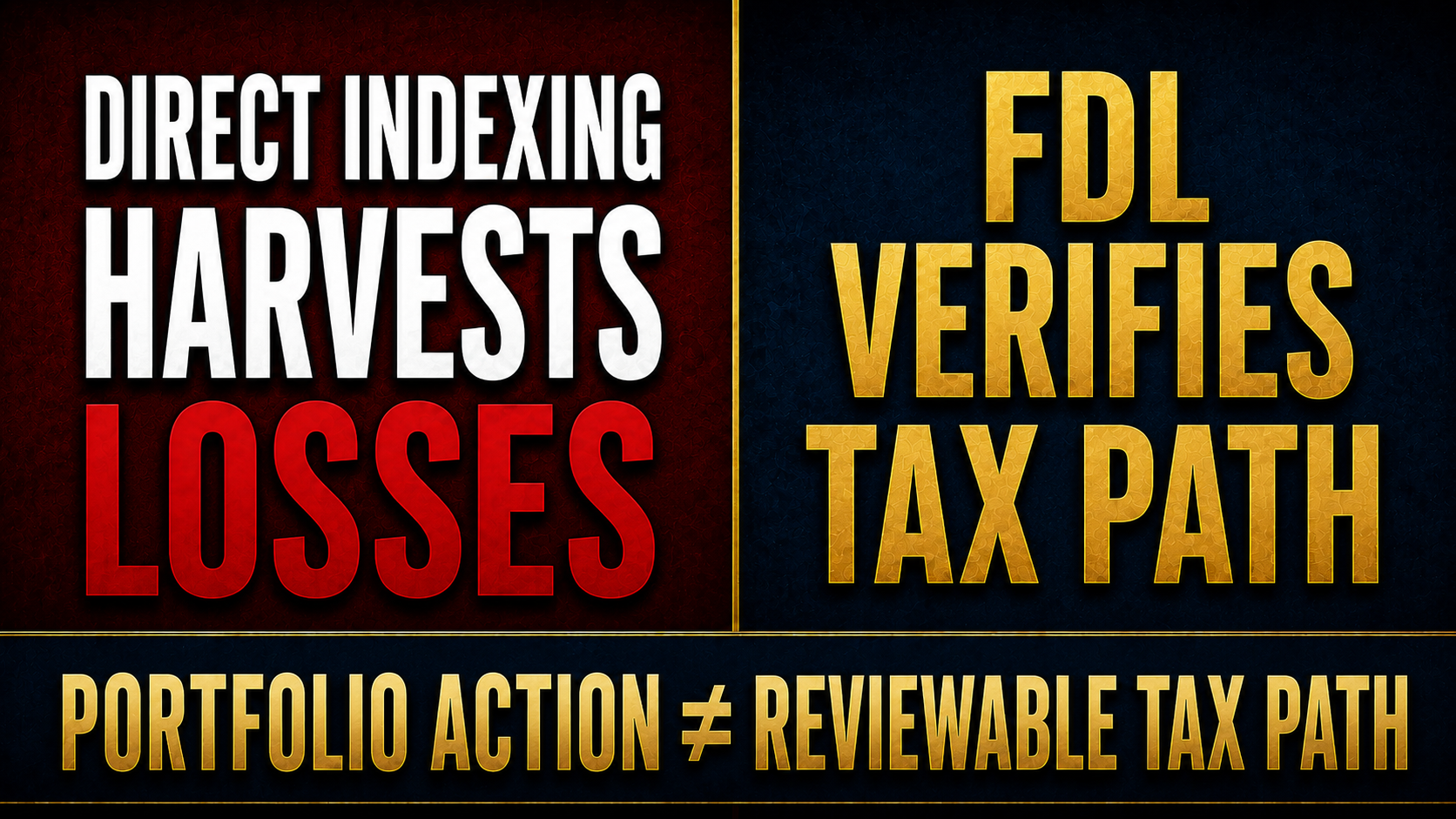
Direct indexing can harvest losses, manage exposure, and implement tax-aware trades.
FDL verifies prepared basis, term, lineage, wash-sale, and audit-trail paths after the activity exists.
Direct indexing can create tax-aware action.
But client-facing value is not complete when the trade is placed.
The advisor still needs the tax path to be visible. The CPA still needs the path to be reviewable.
FDL sits between those needs: it makes prepared tax-lot work visible enough for advisor communication and reviewable enough for CPA sign-off.
THE ROLE SPLIT
Direct Indexing Answers
- what should we trade?
- which losses can be harvested?
- how do we maintain exposure?
- how do we implement tax-aware portfolio action?
FDL Answers
- did the prepared tax-lot path survive?
- are basis, term, wash sales, and lineage reviewable?
- does the Tax Report match the prepared path?
- does the Audit Trail support the number?
Field Guide Rule: Portfolio action is not the same as a reviewable tax path. FDL does not replace direct indexing platforms. It verifies prepared, in-scope tax-lot records after activity exists.
FOR ADVISORS: VISIBLE TAX WORK NEEDS A REVIEWABLE TRAIL
Advisor / CPA Needs
- advisor needs client-facing tax work made visible
- CPA needs a reviewable trail before sign-off
- client needs the tax outcome explained without black-box claims
- tax-aware activity still needs basis, term, lineage, and audit support
FDL Bridge
- Tax Alpha Dashboard makes the work visible
- Tax Report shows the filing-facing result
- Audit Trail preserves the trace behind the number
- FDL verifies prepared, in-scope records without replacing CPA judgment
Translation: FDL does not create a tax-savings claim. It makes professional tax work visible: what was preserved, what was corrected, what remains embedded, and where the audit trail supports the number.
TAX ALPHA DASHBOARD: VISIBILITY, NOT SIGN-OFF
What It Makes Visible
- what was preserved
- what was corrected
- what remains embedded
- which bucket explains the value
- where the Audit Trail supports the number
What It Does Not Do
- does not replace CPA review
- does not promise tax savings
- does not harvest losses
- does not rebalance portfolios
- does not bless unsupported records
The dashboard makes tax work visible. The Audit Trail makes it reviewable.
FDL VERIFICATION COVERAGE MAP
FDL verification is not one failure mode. It makes prepared tax-lot paths reviewable across multiple places where taxable listed-equity records can drift.
Wash Sale Recovery
Preserved loss, basis recovery, Code W treatment, and replacement-lot trace become reviewable.
Specific ID Lot Path
Prepared selected-lot paths can be compared against default FIFO without becoming a recommendation engine.
ACATS Residual Basis
Cross-custodian transfer paths can preserve sold basis, residual inventory, and remaining basis.
Corporate-Action Continuity
Spin-offs, mergers, CIL, and holding-period continuity stay traceable through Tax Report and Audit Trail.
RSU / W-2 Basis
Already-taxed §83 basis can remain visible when payroll records and broker records diverge.
ROC Basis Erosion
Return of capital can reduce basis before sale and make the pre-sale basis path harder to review.
Boundary: FDL verifies prepared, in-scope records. It does not discover truth automatically, normalize every raw broker feed, or replace CPA judgment.
WHERE FDL FITS AFTER DIRECT INDEXING
1. Portfolio Action
Direct indexing platforms can harvest losses, manage exposure, and implement tax-aware portfolio activity.
2. Broker / Custodian Records
Trades, transfers, 1099-B records, account moves, and corporate-action records create the raw tax-lot surface.
3. FDL Verification
FDL verifies prepared tax-lot paths across basis, term, lineage, Tax Alpha Dashboard visibility, Tax Report, and Audit Trail.
Memory line: Direct indexing can create tax-aware activity. FDL makes the resulting tax path visible for advisors and reviewable for CPAs.
WHAT FDL IS NOT
FDL is not a direct indexing platform.
FDL does not manage portfolios.
FDL does not harvest losses.
FDL does not rebalance accounts.
FDL does not replace CPA judgment.
WHAT FDL IS SHOWING
FDL verifies prepared, in-scope tax-lot records after portfolio activity, transfers, or record events exist.
It makes basis, term, lineage, dashboard value, Tax Report output, and Audit Trail support visible enough to review.
Its value is not only the number. Its value is making the tax path reviewable.
CHOOSE YOUR NEXT STEP
FDL — deterministic tax infrastructure for prepared, in-scope records.